
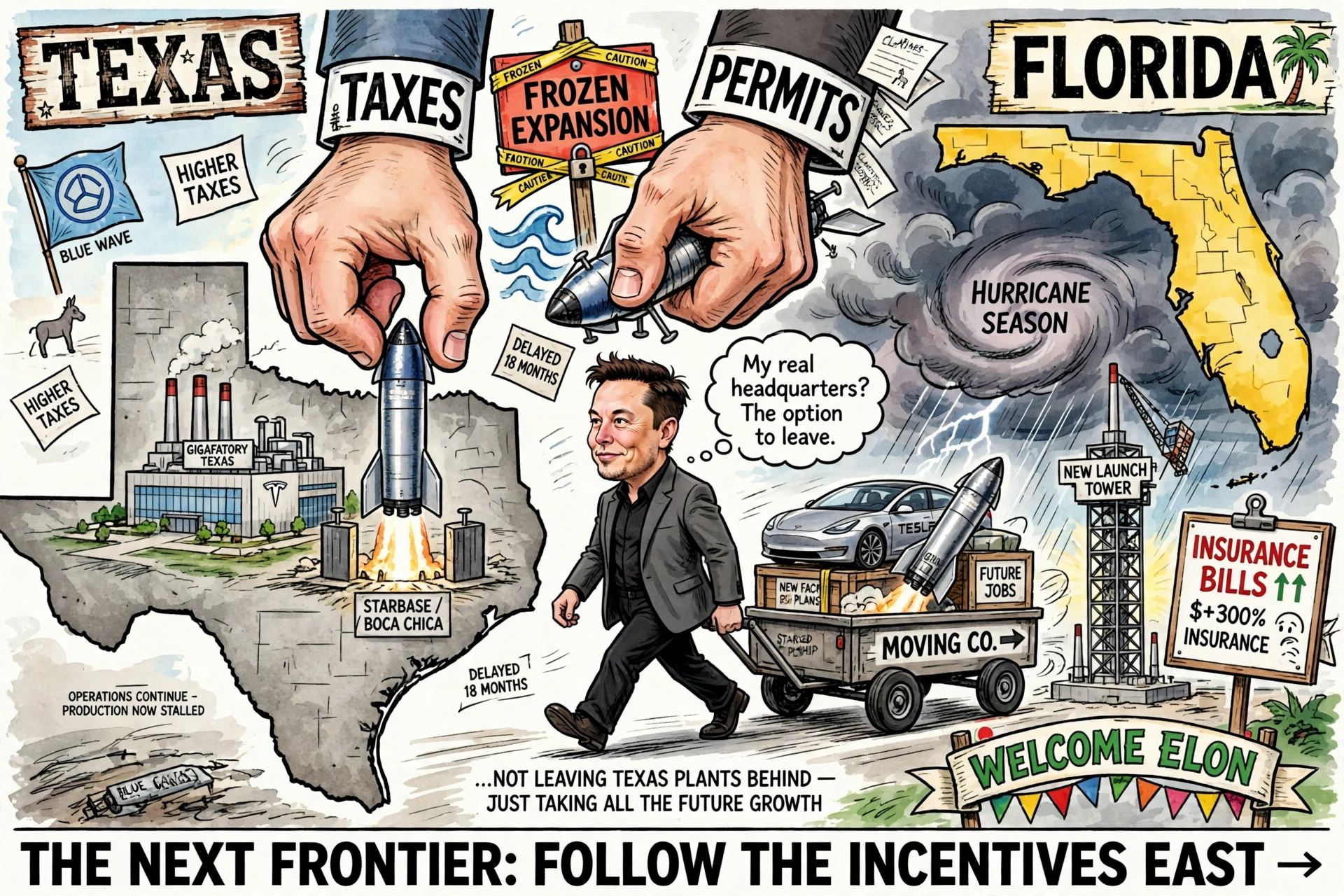
Elon Musk did not move to Texas by accident. He moved Tesla’s headquarters to Austin in 2021, built Gigafactory Texas, moved SpaceX’s headquarters to Starbase at Boca Chica, expanded The Boring Company in Bastrop, put major Neuralink and X operations in the state, and in 2024 reincorporated Tesla in Texas after a Delaware judge voided his pay package. Texas offered what California no longer did: cheap land, fast permits, no state income tax, a governor who wanted him there, and regulators who treated speed as a virtue.
Imagine that bargain reversed. A blue wave sweeps Texas. A self-described socialist governor takes office in Austin, Texas elects a like-minded U.S. senator, and the legislature flips. The new majority does not try to expel Musk — that would be too crude and probably unconstitutional. Instead it squeezes.
That is where the fight would really begin, because Musk is both unusually mobile and unusually stuck. And his response would follow a pattern he has used before: public defiance first, lawsuits second, a freeze on new investment third, and relocation not of what already exists, but of everything that comes next.
The squeeze
The pressure would not arrive as one law. It would arrive as a dozen.
Travis and Cameron County appraisals on the Gigafactory and Starbase rise sharply. The state comptroller reviews and threatens to claw back tax abatements on grounds Tesla and SpaceX missed local hiring or environmental conditions. The Texas Commission on Environmental Quality, under new leadership, slows air and water permits at Boca Chica and reopens questions about launch deluge water, wetlands, and beach closures. Austin tightens building inspections for Tesla’s Cortex AI data center expansion. Legislators propose a special large-employer tax, an EV road fee aimed at Tesla owners, repeal of the direct-sales accommodations Tesla depends on because Texas still protects franchised dealers, and bills requiring neutrality agreements before any state incentive is honored.
Individually, each step is defensible as ordinary regulation. Together, Musk would read them — and describe them on X, hourly — as political retaliation for his endorsements, his ownership of X, and his refusal to fund the new majority’s priorities.
He would probably be partly right about motive and partly wrong about effect. Much of Texas government is not controlled by a governor alone. Counties, courts, federal regulators, and the FAA govern Starbase as much as Austin does. But a hostile state does not need to shut a factory down. It only needs to make the next factory, the next launch tower, and the next 10,000 jobs go somewhere else.
Phase One: Months 0-6 — Defiance and lawfare
Musk’s first move would not be moving trucks. It would be a post: “Texas has decided to punish its largest exporter and most innovative employer. We will fight, and we are evaluating all options.” Stock in Tesla dips, then rallies as investors decide he is bluffing.
Behind the posts, Tesla and SpaceX file suits challenging the tax clawbacks as breach of contract and bills singling out his companies as unconstitutional retaliation. He funds a ballot and lobbying campaign, appears in Austin, warns employees their expansion jobs are at risk, and quietly orders what he ordered in California in 2020 and again in Delaware in 2024: stop all discretionary Texas capital spending until the legal picture clears.
That freeze is the first real economic event. Gigafactory Texas does not close. It employs well over 20,000 people and makes Model Ys and Cybertrucks that cannot be produced elsewhere overnight. Starbase does not close either — its southern latitude and over-water launch corridor cannot be replicated by a press release. But the planned second production tower, new Raptor factory capacity, additional Gigafactory bays for the next-generation vehicle and Optimus robot lines, and thousands of announced-but-not-yet-hired jobs are put on hold.
Phase Two: Months 6-24 — Florida becomes the alternative
Florida is the obvious refuge, and not only because of politics. SpaceX already launches from Cape Canaveral and Kennedy Space Center, leases Launch Complex 39A, builds Starship facilities in Florida, and has thousands of employees there. Governor and legislature would offer Musk what Texas offered in 2020: expedited permitting, tax packages, infrastructure money for roads and power, and a public promise not to change the rules mid-game.
By month nine, SpaceX announces “Starbase East” as its primary future expansion site. New Starship production shifts to the Roberts Road facility at Kennedy, a second Florida launch tower is fast-tracked, and launch cadence planning moves decisively to the Cape. This is feasible, but slow and expensive. Florida’s range is crowded with ULA, Blue Origin, NASA, and the Space Force. Weather, especially lightning and hurricanes, closes more days. Every Starship moved from Texas production to Florida launch adds logistics Musk built Boca Chica to avoid.
Tesla is harder. Around month fifteen, after Florida assembles an inland site — most plausibly in Central Florida near Orlando or along the I-4 corridor, high enough to reduce flood risk — Tesla announces a new, smaller factory for Optimus robots, energy products, and eventually a next-generation vehicle line. He pointedly does not call it a replacement for Gigafactory Texas. He calls it “insurance.” Suppliers understand the signal anyway.
Corporate moves come faster than factories. Tesla and SpaceX reincorporate in Florida, executive offices shift to a new campus near Cape Canaveral and Orlando, and new senior hires are told Florida is home. Austin and Starbase become legacy sites.
Phase Three: Years 3-7 — A partial, expensive divorce
By year three, Texas learns the central truth of modern industrial relocation: governments rarely lose the plant they have; they lose the plant they would have gotten. Gigafactory Texas still runs, but at a planned plateau instead of doubling. Starbase still launches, but Florida catches and then passes it in investment. Engineers who want promotion start moving east.
By year five, perhaps 15,000 to 25,000 direct future jobs that models once assigned to Texas have gone to Florida instead, with tens of thousands more in suppliers, construction, housing, and services. A complete exit never happens. Abandoning billions in sunk Texas assets would punish Musk more than Austin, and his lawyers would advise keeping both sites as leverage against both states.
The impact on Texas
Texas would not collapse — its economy is far too large and diversified — but the reputational wound would be severe. For forty years Texas sold itself to California companies on one promise: we will not do to you what California did. Losing Musk’s future growth, even while retaining his current plants, breaks that brand with exactly the founders Texas most wants.
Regionally it is uneven. Houston’s NASA-linked space sector survives. Austin feels a cooling in tech hiring, commercial real estate, and supplier expansion. Cameron County and Brownsville feel it worst of all. Starbase transformed a poor, remote corner of Texas into a company town. A stalled Starbase means stalled housing, hotels, restaurants, and tax revenue that local governments had already planned around. The state also loses bargaining power: every other large employer learns to demand stronger, longer, court-proof incentive contracts, making future deals more expensive for taxpayers.
Politically, the new majority would claim a victory over a billionaire who tried to bully voters. Critics would answer that ordinary Texans, not Musk, lost the jobs. Both claims would follow Texas into the next election.
The impact on Florida
Florida wins the headline and the headache. Brevard County gains high-paid aerospace work it already knows how to support. Central Florida gains a manufacturing anchor it has long lacked, plus Tesla suppliers, battery logistics, and AI infrastructure. State tax revenue rises without a state income tax, mostly through property, sales, and growth.
But Florida is not Texas in 2020. Land near the coasts is expensive, insurance is a crisis, housing near the Cape is already tight, and a Gigafactory-scale plant needs enormous water and power inland where environmental fights over wetlands and aquifers are fierce. Hurricanes would force expensive hardening Texas never required. Florida Democrats and environmental groups, ironically, would file many of the same lawsuits Texas’s new majority cheered — over manatees, sea turtles, wetlands, and launch noise. Musk would discover that a friendly governor does not repeal geography.
The impact on Musk
Musk survives, poorer in time if not in money. The relocation and duplication likely cost $5 billion to $15 billion over a decade in new facilities, legal fees, tax fights, and inefficiency. Starship development slips perhaps 18 to 36 months because a program designed around build-and-launch in one place is split across two states again. Tesla loses some production learning by dividing future lines.
Yet he gains something he values at least as much: proof that he will leave. That credibility becomes a permanent negotiating weapon with every state and country that hosts him. No future governor, in Texas or anywhere else, could assume his factories are hostages.
The irony is the ending. Musk fled California for Texas to escape politics he considered hostile and irrational. If Texas then squeezed him for the opposite politics, and he fled to Florida, the lesson would not be that he found a state without politics. It would be that no state stays friendly forever — and that Musk’s real headquarters was never Austin or Boca Chica or the Cape.
It is the option to leave.