
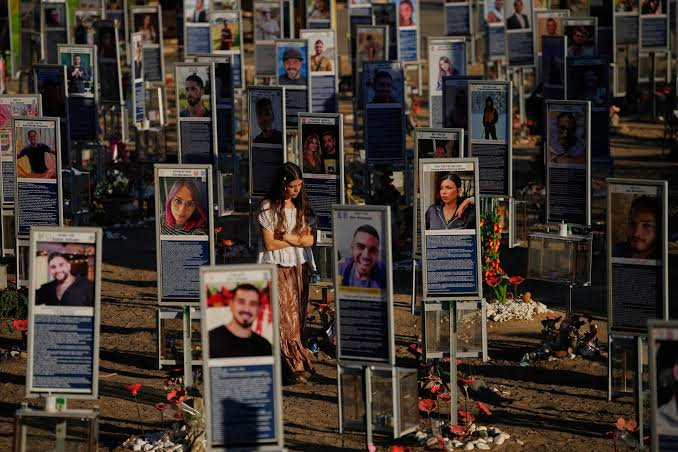
over 1200 innocent Israeli Civilians butchered – over 250 Hostages taken by Hamas Oct 7, 2023
Three years after the October 7, 2023 massacre—the deadliest day for Jews since the Holocaust—the record remains distorted by casualty claims that collapse combatants into civilians, by a legal term (“genocide”) applied without its required specific intent, and by demographic data that show a battered but still-growing population rather than an extermination campaign.
On the morning of October 7, 2023, roughly 6,000 militants and accompanying civilians from Hamas, Palestinian Islamic Jihad, and other groups breached the Gaza border fence under a barrage of thousands of rockets. They attacked military posts and, far more extensively, civilian communities. Approximately 1,200 people were killed, the large majority civilians; more than 250 were taken hostage. At the Nova music festival alone, Israeli military tallies record 378 killed and 44 abducted. In Kibbutz Be’eri, about 100 residents were murdered; similar house-to-house killings occurred in Kfar Aza, Nir Oz, and other communities. Victims included infants, elderly Holocaust survivors, and foreign workers. Attackers filmed and broadcast killings, burnings, and mutilations in real time.
United Nations reporting found reasonable grounds to conclude that sexual violence, including rape and gang rape, occurred at multiple sites (Nova, Road 232, Nahal Oz, and several kibbutzim), and that some hostages were subjected to sexual violence and sexualized torture in captivity. A later Israeli civil commission described the pattern as systematic. These acts meet the definition of war crimes and crimes against humanity under any ordinary reading of international humanitarian law. Hamas’s own founding documents and repeated statements have long called for the elimination of Israel and, in classic formulations, the killing of Jews.
Israel’s subsequent campaign aimed at destroying Hamas’s military capacity, recovering hostages, and preventing repetition. The fighting occurred in one of the world’s densest urban environments, where Hamas had spent years embedding command posts, rocket launchers, and tunnel networks inside and under civilian buildings. The Gaza Health Ministry—an arm of the Hamas administration—has reported roughly 74,000 deaths reaching hospitals by early October 2026, plus thousands missing under rubble. These figures do not distinguish combatants from civilians, and independent analyses have long noted incentives and documented practices of classifying fallen fighters as civilians. Israeli assessments have placed militant deaths in the many thousands; precise public splits remain contested. Civilian deaths in such fighting are tragic and, in specific incidents, may constitute violations requiring investigation. They are also the predictable result of an enemy that maximizes its own population’s exposure.
Palestinian Central Bureau of Statistics estimates place Gaza’s population at about 2.13 million by the end of 2025, down roughly 254,000 (about 10–11 percent) from pre-war projections near 2.3–2.4 million. The decline combines direct deaths, an estimated 100,000-plus who left the territory, and a sharp drop in births caused by displacement, destroyed medical infrastructure, and wartime conditions. Births nevertheless continued at scale: roughly 38,000 in 2024 and on the order of 50,000 in 2025 according to local health data cited in demographic reviews, producing natural increase once non-violent deaths are separated. One analysis of 2025 all-cause mortality data found non-violent deaths near pre-war levels and births still far exceeding them. Life expectancy collapsed in the first year of intense fighting and later partially recovered—an extreme wartime shock, not the demographic signature of a group being destroyed “as such.”
The 1948 Genocide Convention requires specific intent to destroy, in whole or in part, a national, ethnic, racial, or religious group as such, plus prohibited acts. The International Court of Justice has issued provisional measures but has not issued a final merits ruling that Israel possesses that intent. High civilian casualties, infrastructure destruction, and restricted aid flows during active combat can be evidence of unlawful methods of warfare; they do not, by themselves, prove the only reasonable inference is genocidal purpose. Courts have set that bar high precisely because ordinary (and even brutal) war produces overlapping facts.
Scale comparisons clarify the distinction. The Holocaust murdered approximately six million Jews—roughly two-thirds of European Jewry—through industrialized extermination, mass shootings, and deliberate starvation aimed at total elimination. Rwanda’s genocide killed roughly three-quarters of the Tutsi population in weeks. Gaza’s reported direct death toll, even if taken entirely at face value and even if under-counts are added, remains on the order of a few percent of the pre-war population after three years, while births continue and the majority of the population remains in place. Historical pogroms and the Nazi program sought the disappearance of Jewish communities; Gaza’s population trajectory, however severe the absolute losses and destruction, does not match that pattern.
The inversion of this record in parts of Western political discourse is striking. Segments of social-democratic and broader left parties have adopted language that treats the Jewish state—itself the refuge created after the actual genocide and centuries of expulsions—as the principal villain, while softening or omitting Hamas’s explicit eliminationist aims, its use of civilian infrastructure, and the October 7 atrocities. The Communist Manifesto’s framework of class struggle and the overthrow of existing orders has, in some activist lineages, been adapted into an anti-Zionist catechism that subordinates evidence to narrative. Policy differences among mainstream social democrats remain large; the radical current that equates Israeli self-defense with Nazism, however, reproduces older ideological habits of selecting Jews or the Jewish state as the embodiment of illegitimate power. That stance does not become more accurate because it is voiced by parties that otherwise emphasize human rights.
None of this erases Gaza’s devastation: mass displacement, ruined housing and hospitals, and tens of thousands of deaths, including many non-combatants. Those facts demand scrutiny of targeting, aid access, and post-war arrangements. They do not convert a war launched by a massacre, fought against an entrenched armed group that rejects Israel’s existence, into a genocide. Three years on, the demographic and legal evidence still fails the test the term was written to meet – Israel’s response was not genocide – it was the inevitable response after the horrific Oct 7, Hamas attack. A final note of comparison. When the U.S. was attacked on Sept. 11, 2001 – approximately 3,000 Americans were killed. Comparing population sizes – 1200 Israelis with 8 million population would be approximately the same as 40,000 Americans killed.