
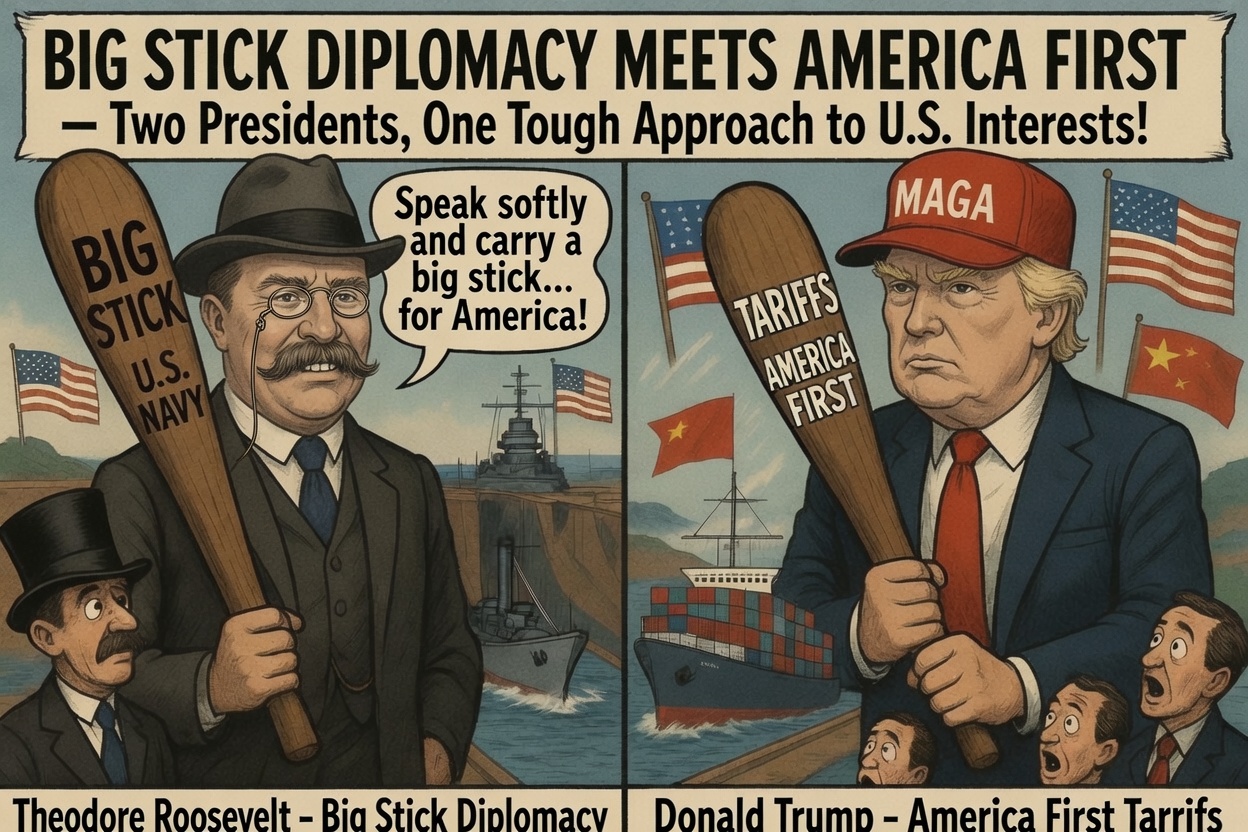
TR and DJT were similar in a couple of obvious ways: Both survived assassination attempts and both projected toughness.
Theodore Roosevelt (TR) and Donald Trump (DJT) also share notable parallels in personality, political style, and assertive nationalism, despite operating in very different eras. Both were New York-born figures from privileged backgrounds who cultivated larger-than-life personas, thrived on public attention, and positioned themselves as outsiders challenging entrenched elites. TR, often labeled a progressive Republican, used his “bully pulpit” to rally support and coined “muckraker” for critical journalists; Trump mastered social media and popularized “fake news” while frequently clashing with (yet engaging) the press.
Both defied GOP party leaders, cast their agendas in moral/populist terms, and pursued energetic foreign policies prioritizing U.S. interests—TR via “Big Stick” diplomacy, Trump via “America First” and tariffs.
TR’s activism included the Panama Canal (supporting Panama’s 1903 independence from Colombia with U.S. naval presence after Colombia rejected canal terms) and military/diplomatic interventions. Trump has echoed this assertiveness: in 2025, he repeatedly threatened to “take back” the Panama Canal (citing Chinese influence, overcharging, and treaty violations) or impose “something very powerful,” framing it as reclaiming U.S. strategic interests in a modern parallel to TR’s canal diplomacy and Roosevelt Corollary to the Monroe Doctrine.
TR as the Archetypal “Trust Buster”
TR earned the “trust buster” label by aggressively enforcing the underused Sherman Antitrust Act (1890) against monopolies he viewed as “bad trusts”—those harming competition, consumers, and the public through price-fixing, predatory tactics, or undue power. Key examples:
- 1902 Northern Securities case: Sued J.P. Morgan’s massive railroad holding company (controlling northern U.S. rail shipping); Supreme Court dissolved it 5-4 in 1904. Morgan reportedly confronted TR directly, treating him like a business rival; TR refused concessions.
- Dozens more suits (about 45 total by 1909), including against John D. Rockefeller’s Standard Oil (broken up in 1911, though decided later) and American Tobacco.
TR supported “good” big business but drew the line at abuses, pairing this with the Square Deal (balancing capital, labor, and public). It was classic progressive-era regulation of industrial trusts.
Trump’s Actions as Interpreted “Trust Busting”
Trump has not used the term “progressive” or filed dozens of Sherman Act suits against industrial monopolies like TR. However, his policies—especially antitrust enforcement against Big Tech and broader economic nationalism—can be interpreted as challenging concentrated power held by modern “trusts” (tech platforms controlling information, commerce, and markets). This aligns with an anti-globalist stance targeting elites and institutions often aligned with Democratic/globalist priorities. Big Tech (and philanthropists like Soros and Gates) frequently opposed Trump rhetorically, funded opponents, or shaped narratives against him (e.g., media ownership, election-related spending, global initiatives).
Key examples of Trump’s antitrust and related actions:
- Big Tech investigations and suits (originating in Trump’s first term, 2017–2021, and continuing aggressively into the second): Trump’s DOJ and FTC launched probes into Apple, Amazon, Google, and Meta/Facebook for alleged monopolistic practices (e.g., exclusionary deals, acquisitions stifling competition, search/ad dominance). The DOJ sued Google in 2020 over search monopolization; the FTC sued Meta in 2020 over Instagram/WhatsApp acquisitions. These targeted companies led by or tied to billionaires like Jeff Bezos (Amazon), Mark Zuckerberg (Meta), and Google’s leadership—figures whose platforms and outlets (e.g., Washington Post under Bezos) were often critical of Trump or supported Democratic causes. Cases advanced or were pursued under Trump appointees even as some Big Tech CEOs later donated to his 2025 inauguration amid shifting dynamics.
In 2025, Trump’s DOJ/FTC continued pressing Google (search and ad-tech wins), Meta, and Amazon suits, with remedies like potential divestitures discussed.
- Broader economic pressure via tariffs and “America First”: Trump’s tariffs (e.g., on China, and 2025 threats on Canada/Mexico over migration/fentanyl) disrupted global supply chains and trade deals benefiting multinational interests. This mirrors TR’s challenge to trusts by using executive power against perceived elite/globalist advantages, framed as protecting U.S. workers over foreign-aligned billionaires.
Actions/rhetoric targeting specific opposing billionaires (Soros, Gates, Bezos):
- George Soros: Trump repeatedly criticized Soros as funding anti-Trump protests and “globalist” causes. In his second term, the Justice Department investigated Soros’s Open Society Foundations for alleged issues (arson, terrorism support claims—though evidence was contested). Trump called him a “bad guy” who “should be put in jail” and suggested RICO charges. This is not literal antitrust (Soros’s influence is philanthropic/political, not a commercial trust) but fits a pattern of using federal scrutiny against a major Democratic/globalist funder.
- Jeff Bezos (Amazon/Washington Post): Amazon faced ongoing FTC antitrust suits (filed earlier but pursued) over e-commerce dominance. Trump’s public feuds with the Post (critical coverage) and tariffs indirectly pressured global retail/logistics models.
- Bill Gates: More rhetorical—Trump criticized Gates’s global health/philanthropy influence (e.g., vaccines, climate) as part of elite overreach. No direct “bust,” but it ties into anti-globalist themes. Gates and Soros were seen as Democratic backers.
These are not identical to TR’s courtroom trust-busting (TR targeted industrial cartels via explicit Sherman Act enforcement). Trump’s approach blends antitrust (modern tech monopolies as information/economic gatekeepers), executive pressure, tariffs, and targeted investigations—often against entities perceived as aligned against him on the “Democrat Globalist side.” Critics argue some Big Tech donations to Trump later softened enforcement or made it leverage-based; supporters see it as populist pushback against unaccountable power, akin to TR’s Square Deal.
Although many pundits will not see the connection of TR’s Trust Busting activities to DJT’s attacks on the opposition political elites the same, the analogy holds in spirit: both presidents used presidential power to confront concentrated economic/political elites they viewed as threats to American interests, even if methods and targets evolved with the times. TR regulated Gilded Age railroads/oil; Trump targeted digital platforms and globalist networks. The Panama parallel reinforces the activist, nationalist thread. Historical comparisons are interpretive, but these overlaps explain why enlightened observers connect the dots from TR’s progressivism to Trump’s anti-globalism.