
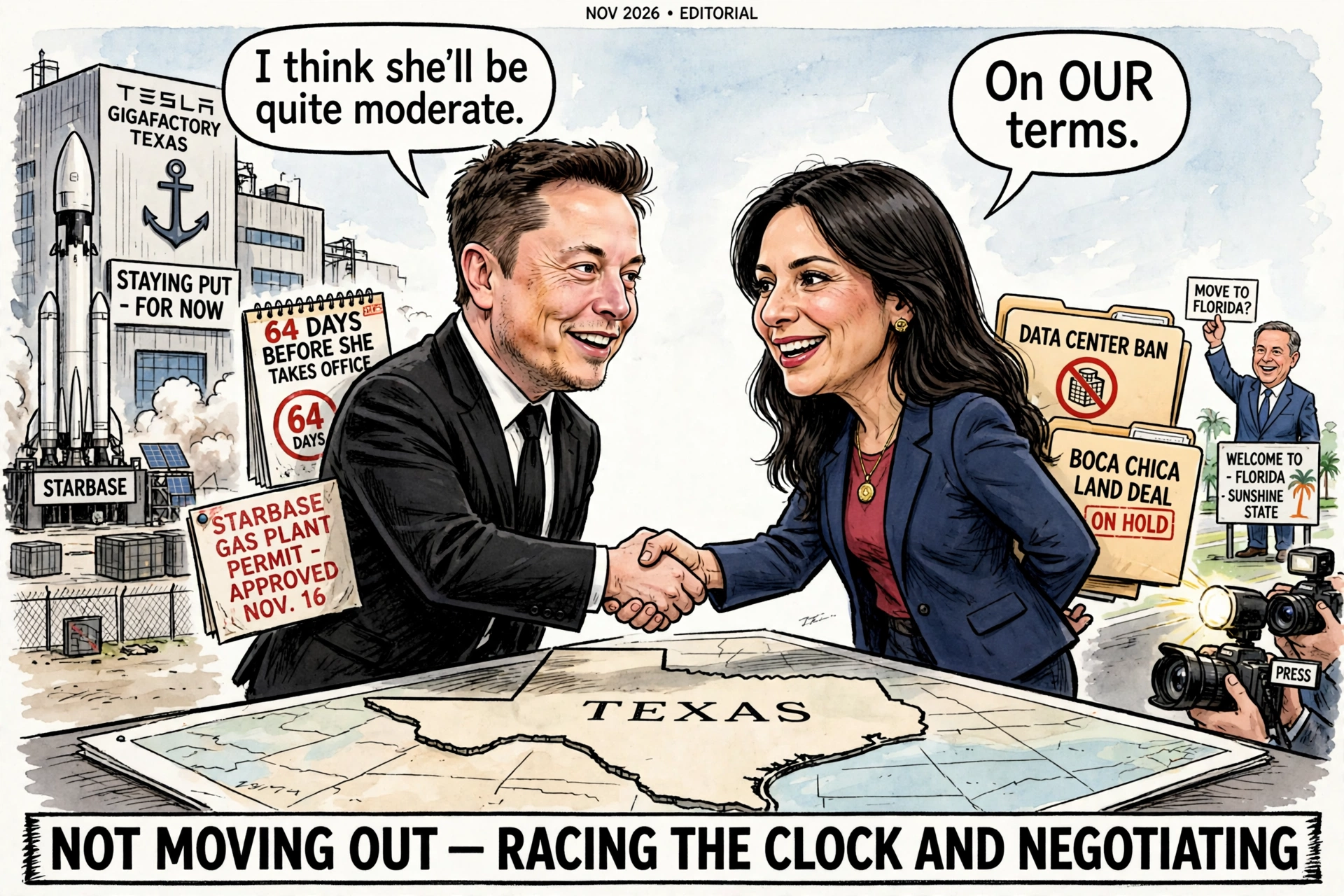
My first version of this story had a clean arc: Texas turns socialist, Texas squeezes Elon Musk, Musk fights, freezes investment, and takes the future growth of Tesla and SpaceX to Florida. Real events since the election have kept the cast and the stage, but changed the plot. Musk is not loading a truck. He is doing something more interesting, and in its way more Musk-like: publicly making peace with the woman who beat his candidates, while racing her inauguration clock to lock in the one permit he needed most.
Start with what the voters actually did. Musk spent at least $445 million nationally this cycle trying to keep Republicans in power, including $158 million behind a super PAC backing Ken Paxton for Senate in Texas — and Democrat James Talarico beat Paxton anyway. Gina Hinojosa, the first Democrat elected governor of Texas since Ann Richards in 1990, beat Greg Abbott.
But Hinojosa is not the governor from my original premise. She did not run on taxing Tesla or expelling SpaceX. She won on lowering the cost of living, improving public schools, and cutting property taxes. Her two real quarrels with Musk are specific. First, data centers: she promised to ban “all data center approvals” until the Legislature passes new protections, arguing rural communities have been taken advantage of on water and power with no rules to protect them. Second, public land: she campaigned against the Boca Chica State Park deal for SpaceX and asked that no action be taken on it during the transition. Everything else is a negotiating posture, captured in her Nov. 5 formula: “We can have a strong working relationship with Elon Musk and his companies, but it has to be on our terms. It cannot be just running over the people of Texas”. She has also said plainly that she is not against data centers as such and that Texas remains pro-business.
Musk’s response followed a curve I did not predict. On election night he joked that his “election-interfering space lasers didn’t work,” then posted that “data centers in space looking pretty appealing right now”. On Nov. 7 came the one genuinely sharp shot: SpaceX and Tesla had prospered in Texas “because we were not constantly operating under an oppressive and extractive state government,” as California had become with “extreme taxes and overregulation”. That sounded like the opening of the war in my first essay.
It wasn’t. It was the peak. By Nov. 18, at the DealBook Summit, Musk was calling his election spending foolish — “I feel pretty foolish about having spent so much money and not seeing much for it” — and going out of his way to bless the incoming governor: “The new governor, actually, I think, is going to be quite moderate. I don’t think she’s sort of a far-left governor. And based on everything I’ve heard about her, I think things will be fine in Texas with Gina as governor”. He even reframed the blue wave as healthy balance of power. A man preparing to move two headquarters does not talk like that. A man who has just learned the price of political spending, and is opening a negotiation, does.
Meanwhile, the one move I expected in month nine happened in week one — and fizzled. On Nov. 9, Florida Rep. Carlos Giménez formally invited Musk to “consider relocating its corporate headquarters and expanding its operations from Texas to the free state of Florida”, warning of “excessive government interference” and “policies that punish success” in Texas. In my first timeline, Florida’s pitch was a state-backed incentive package that Musk used as his landing zone. In reality it is, so far, one congressman’s letter, with no public answer from Musk. Florida is no longer the destination in this story. It is the prop on the table — visible to Hinojosa every time she sits down with him.
The genuinely fast action happened where almost nobody was looking: in the permit queue. Texas had paused data center permits in September while ERCOT audited projects waiting for power. On Friday, Nov. 13, Abbott’s office lifted that pause, even though ERCOT’s final report is not due until Dec. 10. On Monday, Nov. 16, the state environmental agency issued SpaceX’s emissions permit for the gas plant that will power its AI data center at Starbase — 64 days before Hinojosa takes office, through a standard registration with no public notice. SpaceX’s plant will not connect to the state grid, so it needed no place in that line either. Two days later, Musk delivered his “things will be fine with Gina” line, and did not mention the permit.
That sequence replaces my original Phase One. Musk’s first move was not defiance and lawsuits. It was vesting: getting the critical approval issued under a friendly outgoing administration, so the incoming governor’s ban has to answer a hard legal question — can it reach a permit already granted? Her pledge does not say, and a watchdog complaint that SpaceX began building before the permit arrived is now the live challenge.
The revised timeline
Now to January 19, 2027 — the transition race. Expect public truce and private bargaining. Hinojosa holds two cards: the Boca Chica land decision, which she has already frozen for her own term, and the Legislature’s data-center bill. Musk holds two cards of his own: the Starbase permit, and the unanswered Florida letter. The Dec. 10 ERCOT report is the next tell — it will shape how broad a data-center pause Texans will accept. No headquarters move is likely in this window. I would put it at 10-15%.
January to June 2027 — the legislative test. This is where the story is decided, not in posts on X. If the Legislature produces a compromise — local consent, water and power protections, and grandfathering for permits already issued — Musk stays, expands under rules he dislikes but can price, and Texas keeps both the plants and the growth. Hinojosa gets to say she ended the era of Musk running over Texans without costing Texas a single Gigafactory job. That is a deal both of them can sell, which is why it is the most likely outcome.
Mid-2027 onward — the conditional break. My original Florida scenario has not died; it has been demoted to a fallback, and narrowed. If Hinojosa’s administration tries to revoke or strand the Starbase permit, kills the Boca Chica land deal outright, and enacts a data-center regime that reaches xAI’s Texas plans, then the sequence I described before switches on — but in a specific order. First to freeze would be new Texas AI and data-center growth, the one sector she has actually targeted. Second would be incremental SpaceX growth drifting to Cape Canaveral, where he already operates. Tesla, against which no measure has been aimed at all, would be last — and its headquarters move would be a signal, not a necessity.
What that changes for the three parties
For Texas, the risk is no longer losing Musk. It is a slower, quieter cost: every future site decision he makes now gets priced against a state that elected a governor who campaigned against his land deal and his data centers, and a permit system where approvals can become election issues. Texas keeps the jobs it has. Whether it keeps the next round is a 2027 question, not a 2026 one.
For Florida, the windfall I predicted has shrunk to an option. Giménez’s letter cost Florida nothing and buys it a permanent seat in Musk’s negotiations, but until Musk answers it — or a breakdown in Austin makes him need it — Florida gets the headline without the factories, the launch towers, or the hurricane-and-insurance problems that came with them in my first version.
For Musk, the revised story is cheaper and better than the one I wrote for him. No $5-15 billion duplication, no 18-to-36-month Starship delay. Instead he spent roughly half a billion dollars learning that his money could not buy Texas, salvaged the permit that mattered most in the 64 days before the new sheriff arrived, and discovered that the incoming governor would rather bargain than fight. His real loss is not in Texas at all. It is the demonstration, visible to every politician in America, that opposing Musk and winning is survivable.
The punchline of the first essay still stands, but it needs a tense change. His real headquarters is the option to leave. He is just not exercising it. He is renting it out, month by month, as leverage — and so far, in this revised timeline, the rent is coming in on time.